


How & Where To Find New Car Deals & Incentives
Quick Links
- Plan ahead and save with our guide to deals and incentives
- 1. Start With Manufacturer Websites
- 2. Check Large Car Buying Platforms
- 3. Understand The Power Of Timing
- 4. Look Beyond The Headline APR
- 5. Don’t Ignore Broker Deals
- 6. Consider Pre-Registered And Nearly-New Cars
- 7. Ask Direct Questions In The Showroom
- 8. Check Eligibility For Specialist Incentives
- 9. Compare Like With Like
- What About Cash Buyers?
- Quick Checklist: Spotting A Genuine Deal
- Our Final Word
Plan ahead and save with our guide to deals and incentives
There’s a quiet assumption that new car prices are fixed. The figure on the screen is the figure you pay. End of story.
In reality, very few people pay the full list price.
Behind the advertised RRP sits a shifting landscape of deposit contributions, finance support, manufacturer incentives and dealer targets. Some offers are national. Others exist for a few days at the end of a quarter. A few aren’t advertised at all unless you ask the right question.
Deals are not just about the sticker price. Knowing which incentives are available in the UK, who provides them, and how they affect the total cost can prevent wasted effort and help you spot genuine savings quickly.
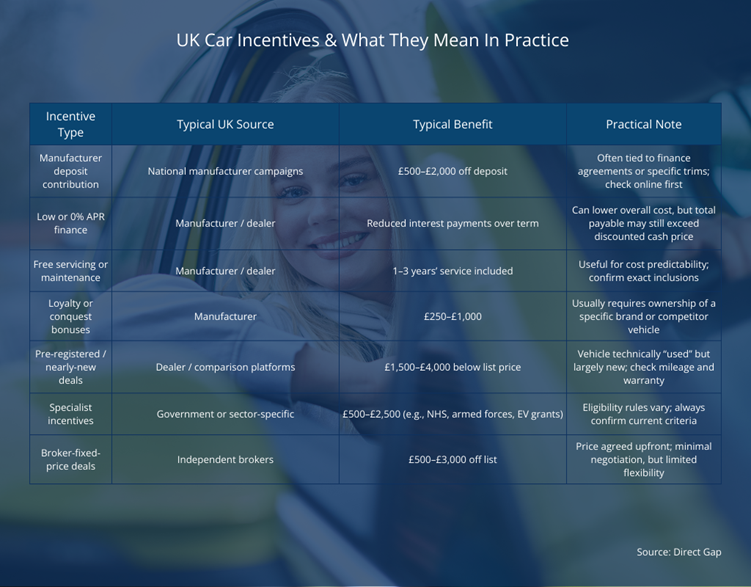
Table: UK new car incentives & what they mean in practice
The challenge isn’t whether deals exist. It’s knowing where to look, what’s genuinely valuable, and what simply sounds impressive.
If you’re considering a brand-new car, here’s how to find real savings and avoid being distracted by the wrong numbers.
1. Start With Manufacturer Websites
Your first stop should always be the manufacturer’s official website.
Brands regularly publish national offers that apply across their UK dealer network. These can include:
- Deposit contributions
- 0% or low APR finance
- Free servicing packages
- Loyalty bonuses
- Electric vehicle incentives
These offers are often time-limited and tied to specific trims or engines. They may also change quarterly, as manufacturers align promotions with sales targets.
The benefit of starting here is clarity. You can see what support is officially available before stepping into a showroom. That makes it much easier to spot whether a dealer is adding value, or simply presenting a national offer as something exclusive.
It also helps you compare brands properly. A car with a higher list price but a strong deposit contribution can sometimes work out cheaper than a “discounted” rival.
2. Check Large Car Buying Platforms
Websites such as Auto Trader and Carwow allow you to compare offers across multiple dealerships.
These platforms often show:
- Discounted cash prices
- Pre-registered vehicles
- Broker-style deals
- Finance illustrations
Because dealers compete against one another, pricing can be more aggressive than what you’ll see advertised locally.
However, it’s important to read carefully. Some headline discounts apply only to finance agreements. Others may be based on pre-registered cars, which technically have had a previous keeper (usually the dealership itself).
That isn’t necessarily a problem. But it’s worth understanding exactly what you’re buying.
3. Understand The Power Of Timing
New car deals often align with sales targets.
Dealerships operate on monthly, quarterly and annual goals. As deadlines approach, flexibility can increase. That doesn’t mean every end-of-month visit guarantees a bargain, but timing can help.
March and September are particularly significant in the UK due to new registration plates. These months typically see higher volumes and stronger incentives.
Equally, the final week of a quarter can be useful. If a dealer is close to hitting a volume target, an extra registration may unlock manufacturer bonuses that outweigh the discount they offer you.
It’s rarely dramatic. But sometimes it’s enough to make a meaningful difference.
Read More: The Only Car Buying Guide You'll Ever Need.
4. Look Beyond The Headline APR
A common trap is focusing solely on interest rates.
A 0% APR offer sounds unbeatable. And sometimes it genuinely is. But finance packages are built from several moving parts:
- Vehicle price
- Deposit contribution
- Interest rate
- Term length
- Guaranteed Future Value (if PCP)
The Financial Conduct Authority provides guidance on how car finance is structured and why the total amount payable matters more than a single percentage figure.
For example, a slightly higher APR combined with a larger manufacturer deposit contribution can result in a lower overall cost.
It’s not about chasing the lowest rate. It’s about looking at the complete picture.
Read More: Decided on PCP for your next car? Read How To Get The Best PCP Deal.
5. Don’t Ignore Broker Deals
Car brokers act as intermediaries between buyers and supplying dealers. They don’t usually hold stock themselves, but they can access substantial discounts by placing high volumes of orders.
Many broker deals appear on comparison platforms, but some operate independently and publish fixed-price offers.
The appeal is simplicity. The price is agreed upfront, often significantly below list. The trade-off is reduced room for negotiation and less flexibility around part exchange.
For straightforward buyers who value price over showroom experience, brokers can represent some of the strongest savings available.
6. Consider Pre-Registered And Nearly-New Cars
If your goal is maximum value rather than being the very first registered keeper, pre-registered cars deserve attention.
These are brand-new vehicles that have been registered by a dealer to meet targets but have little to no mileage.
Because they’re technically “used,” pricing can be noticeably lower. (Remember, this is a common trait across all used cars, so Gap Insurance is always worth putting in the mix no matter what you buy, protecting you against any complications later on).
You’ll still receive the balance of the manufacturer warranty, and the car will feel entirely new in day-to-day use. The compromise is that you’ll appear as the second keeper on paper.
For many buyers, that’s a small trade for a substantial saving.
7. Ask Direct Questions In The Showroom
Even with online research, some incentives aren’t heavily advertised.
It’s reasonable to ask:
- Are there any additional deposit contributions available?
- Is there flexibility on the on-the-road price?
- Are there loyalty or conquest offers?
- Can you include servicing or accessories?
Polite, informed questions tend to produce better outcomes than aggressive negotiation.
Dealers have margins. They also have limits. The goal isn’t confrontation. It’s clarity.
Read More: Questions To Ask When Visiting A Dealership.
8. Check Eligibility For Specialist Incentives
Some discounts apply only to specific groups.
These may include:
- NHS or emergency services staff
- Armed forces personnel
- Existing brand customers
- Company car drivers
- Electric vehicle grant schemes (where applicable)
Eligibility rules change over time, particularly for EV-related support. The government’s EV infrastructure and grant information pages outline which schemes are currently active and who qualifies.
It’s worth checking. Even modest incentives can shift the numbers meaningfully.
9. Compare Like With Like
One of the easiest ways to misjudge a deal is by comparing different specifications.
A heavily discounted base model may look attractive next to a lightly discounted higher trim. But once you add desirable options, the gap narrows quickly.
Focus on:
- Identical trim levels
- Equivalent engines or battery sizes
- Matching finance terms
- Similar mileage allowances (if leasing or PCP)
Only then does the comparison become meaningful.
Otherwise, you’re reacting to noise.
What About Cash Buyers?
There’s a persistent belief that paying cash guarantees the biggest discount.
That’s no longer always true.
Manufacturers frequently support finance agreements because they generate long-term revenue. As a result, some of the strongest incentives are tied to PCP or HP packages.
In certain cases, buyers take manufacturer finance to access a deposit contribution, then settle the agreement early. This can work, but it’s essential to understand any settlement rules and potential interest implications before proceeding.
The key point is simple: cash isn’t automatically king. It’s just one option.
Quick Checklist: Spotting A Genuine Deal
When reviewing an offer, ask yourself:
- Is the discount coming from the dealer, the manufacturer, or both?
- Is the incentive conditional on finance?
- Are there mileage limits or balloon payments to consider?
- Have I compared this against at least two other suppliers?
- Does this car genuinely fit my needs, or am I reacting to the offer?
A good deal on the wrong car is still the wrong car.
Our Final Word
New car deals aren’t rare. They’re layered.
The strongest offers usually combine manufacturer support, dealer flexibility and careful timing. The buyers who benefit most aren’t the most aggressive. They’re the most informed.
If you research widely, compare properly and ask calm, direct questions, you’ll quickly see where genuine value sits.
And when the numbers finally make sense, you won’t feel like you’ve “won” a negotiation.
You’ll simply feel confident you paid the right price.
Which, in the long run, matters far more.
Pin It!


Luke Sanderson
Luke is our resident copywriter, combining plenty of automotive experience, particularly in car sales with a commitment to well-researched, extensive writing. He draws on his own experiences, as well as quizzing the entire team at Direct Gap to ensure the blogs and articles you read are worthwhile, valuable and accurate. Got a question for Luke? Drop us a DM on social media and he'll be happy to help.