
Are Second Hand Electric Cars Worth Buying? Here's Everything You Need To Know
Electric cars long since stopped being rare; they're now a normal part of everyday motoring. With that, prices have reduced significantly, in part, due to a growing number of options from mainstream brands and cheaper Chinese alternatives.
Brand-new EVs might still look relatively expensive on paper, but the used market can be a different story. That's why many drivers, like you, are asking the same question: should you buy a used EV, or not?
Let's break it down properly.
Are Used Electric Cars Worth Buying?
For many drivers, a used electric car can be worth considering. Buying second-hand can mean a significantly lower purchase price than buying the same or a similar EV new, while you may also benefit from lower day-to-day running and maintenance costs compared with some petrol or diesel cars.
However, whether a used electric car is a good buy will depend on the individual vehicle and how well it fits your lifestyle. Battery health, remaining battery warranty, real-world driving range, charging speed and access to affordable charging are all important factors to consider before you buy.
It’s also worth looking beyond the initial purchase price. Check how much the car will cost to insure, how well it has retained its value, its service and maintenance history and whether its range comfortably covers the journeys you make regularly.
If the battery is in good condition, the range meets your needs and you have convenient access to charging, a used EV could offer good value. The key is choosing the right electric car for your budget and how you actually drive.
Used Electric Cars: Pros & Cons At A Glance
| Advantages | Things To Consider |
|---|---|
| Lower purchase price than equivalent new EV | Battery health and degradation |
| Avoid some of the steepest early depreciation | Remaining battery warranty |
| Potentially lower home-charging costs | Public charging can be expensive |
| Fewer routine mechanical components | Real-world range may be lower than when new |
| Wide choice of increasingly affordable models | Insurance costs vary considerably |
| Zero tailpipe emissions | Charging access needs to suit your lifestyle |
Why Used EVs Suddenly Look Affordable
A few years ago, electric cars felt financially out of reach for many UK households. That perception has shifted fast.
Several things happened at once:
- Company car drivers cycled through tax-efficient EV leases
- Early adopters upgraded to longer-range models
- Manufacturers ramped up production
- Tesla cut new car prices aggressively in 2023–2024
- Supply began outpacing demand
The result? Used prices softened sharply.
Market data from platforms such as Auto Trader showed used EV values dropping significantly between 2022 and 2024, in many cases faster than equivalent petrol or diesel models.
Depreciation hurts the first owner, but it can help the second.
Cars like the Tesla Model 3, once comfortably north of £40,000 new, are now widely available in the mid-£20,000s. Earlier electric pioneers, such as the Nissan Leaf or BMW i3, can cost less than many used petrol superminis.
Read More: Find out more about Why Do Cars Depreciate?
How Much Could You Actually Save?
Let’s move from theory to numbers.
The average UK driver covers around 7,000 miles per year, according to the Office for National Statistics.
That’s under 20 miles per day.
Now look at typical running costs for 8,000 miles per year:
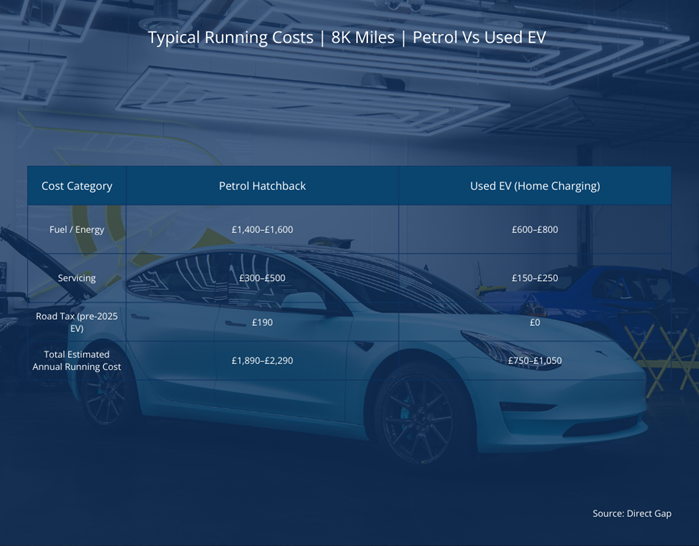
Electricity on an off-peak tariff can cost as little as 7–10p per kWh. That often works out at 7–9p per mile.
Petrol at £1.45 per litre typically works out closer to 17–20p per mile.
Over 8,000 miles, that difference alone can approach £800–£1,000 per year.
Public rapid charging is more expensive, often 60–80p per kWh, so the savings depend heavily on whether you can charge at home.
That detail matters.
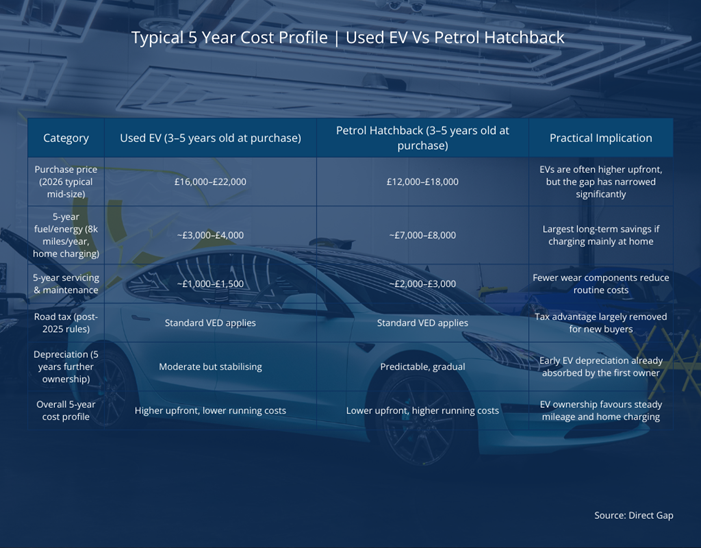
Annual savings are important, but most buyers keep a used car for several years. Looking at a typical five-year ownership period helps show how fuel, servicing and depreciation interact in the real world for an average UK driver covering around 7,000–8,000 miles per year.
The Big Question: What About the Battery?
This is the psychological hurdle.
We understand engines. Pistons, oil, timing belts. Batteries feel different, abstract, chemical, expensive.
Here’s what real-world data tells us.
Most manufacturers offer battery warranties of around eight years or 100,000 miles. That’s legally binding protection against excessive degradation.
Fleet data and independent studies suggest most EV batteries lose roughly 1–2% capacity per year. Reporting from organisations like RAC shows many five-year-old EVs retaining over 85% of their original capacity.
What does that mean in practice?
A car with 250 miles of range when new may deliver around 215–225 miles after several years.
For most drivers, that’s more than enough.
Unlike engines, battery degradation is typically gradual rather than catastrophic. There’s typically no sudden “failure” moment. Capacity tapers slowly.
Before buying:
- Confirm the remaining battery warranty
- Request a battery health report if available
- Check real-world range reviews
- Compare original range vs current estimate
And remember, the average driver isn’t doing 200 miles every day.
Read More: EV Batteries Everything You Need To Know.
Charging: The Deciding Factor
If you have off-street parking, EV ownership is straightforward.
You plug in overnight, wake up to a “full tank” and rarely think about it again.
If you rely entirely on public charging, it’s still possible, but it requires planning.
The UK charging network has expanded rapidly. Platforms like Zap-Map track tens of thousands of public charge points, showing availability and speed.
National Grid data indicates electricity capacity is expanding in line with EV adoption. Infrastructure upgrades are ongoing.
But convenience isn’t just about national statistics. It’s about your routine.
Ask yourself:
- Can I install a home charger?
- Are reliable chargers near my home or work?
- How often do I drive long motorway routes?
If charging fits naturally into your week, a used EV makes sense.
If it feels like a logistical puzzle, it may not.
Read More: We've covered charging in greater detail in our guide; EV Chargers | Everything You Need To Know.
Best Used EVs To Consider in 2026
Not all used EVs are equal.
Some stand out for value and reliability:
Tesla Model 3
- Strong real-world range
- Excellent charging network access
- Software updates over the air
- Watch insurance costs
Hyundai Kona Electric
- Impressive range for price
- Efficient drivetrain
- Good reliability reputation
BMW i3
- Distinctive design
- Lightweight carbon construction
- Shorter range but excellent for city use
Choosing the right battery size matters more than choosing the newest registration plate.
Reliability: What Actually Goes Wrong?
Electric motors are mechanically simple. Fewer moving parts means fewer wear components.
Breakdown data from organisations like AA suggests EV callouts are increasingly routine and manageable.
Common issues:
- 12V battery failures
- Software glitches
- Charging port faults
Notably absent:
- Clutch replacements
- DPF blockages
- Timing belt failures
If your driving is mostly short journeys, avoiding diesel particulate filter issues alone can be a relief.
As with any used car:
- Check service history
- Confirm recall completion
- Test suspension and brakes thoroughly
EVs aren’t immune to problems. They’re just different problems.
What Should You Check When Buying a Used Electric Car?
Here's a list of things you should consider checking before buying a used EV:
- Battery health / State of Health (SoH): Ask whether a battery health report is available.
- Remaining battery warranty: Check both age and mileage limits and whether the warranty transfers.
- Real-world range: Don't rely solely on the dashboard estimate during a short test drive.
- Charging speed: Check AC and DC charging capability because older EVs can be substantially slower.
- Charging connector: Especially relevant to older EVs.
- Service history
- Outstanding recalls
- Tyres: EV weight/torque can make tyre condition particularly relevant.
- Brakes: Regenerative braking can mean conventional brakes are used differently.
- Charging cables
- Software/infotainment support
Pay Some Attention To Software Too
Whoever thought software would become an important consideration when it comes to buying a car? These days, most cars run on some sort of software, with electric cars being the most dependent.
We don't think you should worry about it too much, but it can be beneficial to at least give software some thought. Here are some additional software-related things to think about:
- Is the infotainment system still supported?
- Does the manufacturer provide over-the-air updates?
- Are navigation/charging features still maintained?
- Does the mobile app still support the model?
- Are connected services subscription-based?
- Does the manufacturer have an established UK service/repair network?
- How long has it committed to software/security support?
Environmental Impact: Does Buying Used Help?
Manufacturing an EV does produce higher upfront emissions due to battery production.
However, studies from organisations such as Energy Saving Trust show that over their lifetime, EVs typically produce significantly lower total emissions than petrol or diesel cars, particularly as the UK electricity grid becomes greener.
Buying used improves the equation further.
The car already exists. The embedded carbon has already been emitted.
You’re extending lifespan, not triggering new manufacturing.
When a Used EV Might Not Suit You
Let’s be honest.
A used EV may not work well if:
- You tow heavy loads regularly
- You lack reliable charging access
- You frequently drive 250+ motorway miles in one stretch
- You dislike adapting routines
There’s also a preference.
Some drivers love the quiet immediacy of electric torque. Others miss engine noise and gear changes.
That’s not right or wrong. It’s personal.
Market Outlook: Will Values Hold?
No one can predict perfectly.
Battery technology will improve. Charging speeds will increase. That could pressure older models.
But demand for affordable EVs is rising as new petrol and diesel bans approach 2035.
The used market today is more mature and predictable than it was three years ago. It’s no longer speculative hype. It’s normal retail supply and demand.
That stability reduces risk.
Protecting Your Investment: Do You Need GAP Insurance on a Used EV?
One area many buyers overlook, whether they’re choosing petrol, diesel or electric, is what happens if the car is written off or stolen.
Electric vehicles, particularly models like the Tesla Model 3 or Hyundai Kona Electric, have experienced sharper early depreciation than many traditional cars. While that benefits you as the second owner, values can still shift quickly depending on battery tech updates and wider market trends.
If your insurer pays out the current market value after a total loss, there can be a shortfall between that payout and:
- What you originally paid
- The outstanding finance balance
- The cost of replacing it with a similar model
That’s where GAP (Guaranteed Asset Protection) insurance can make sense. It’s designed to cover the difference between your insurer’s settlement and either your invoice price or remaining finance, depending on the policy type.
If you’re financing your used EV, or simply want to protect the upfront investment you’ve made, it’s worth understanding how EV GAP cover works before you complete your purchase.
It’s not a legal requirement, but when you’re buying a vehicle that still represents a significant financial outlay, it’s one of those practical considerations that can provide real peace of mind, especially in a market that’s still evolving.
Read More: We've got everything covered in our Complete Gap Insurance Guide.
Frequently Asked Questions
How long do EV batteries last?
Most are designed to last well beyond eight years, with gradual degradation rather than sudden failure.
Is replacing a battery expensive?
Yes, but full replacements are rare. Warranty coverage typically protects against major failure.
Are used EVs cheaper to maintain?
Generally yes. Fewer moving parts mean lower routine servicing costs.
Do used EVs still qualify for incentives?
Most purchase grants have ended, but tax advantages and emissions zone exemptions may still apply. Check official guidance via GOV.UK.
Is public charging expensive?
It can be. Home charging is where the biggest savings occur.
Our Final Word
In 2026, for many UK drivers, the answer is increasingly yes.
If you:
- Have access to charging
- Drive average annual mileage
- Choose the right battery size
- Buy carefully
A used EV can offer:
- Lower running costs
- Smooth, quiet driving
- Reduced mechanical complexity
- Strong value relative to new
It isn’t a leap into the unknown anymore.
It’s a considered decision.
Be honest about how you actually drive. Not the once-a-year holiday trip. The normal week. The school run. The commute. The supermarket.
If the numbers work and charging fits your life, a used electric car isn’t a compromise.
It’s simply practical.
And increasingly, it makes straightforward financial sense.
We hope this has helped clear things up and help you get closer to a decision. If it has, don’t forget to share it with your friends, they might find it useful too!
You can also share this blog using our Pinterest-friendly image, below.
Pin It!