
Considering GAP Insurance But Not Sure Whether It Fits Your Needs? Here’s Everything You Need To Know.
1 Minute Read
GAP (Guaranteed Asset Protection) Insurance is designed to cover certain financial shortfalls if your vehicle is written off or stolen and declared a total loss.
Your standard motor insurer will usually base its settlement on what your car is worth at the time of the claim. Depending on the GAP policy you choose, additional cover can then help bridge the difference between that settlement and what you originally paid, what you still owe on finance, or the cost of replacing the vehicle.
So, is GAP Insurance worth it?
For most drivers, absolutely. If your car depreciates considerably, you have a large finance balance or you'd struggle to cover a shortfall yourself, GAP Insurance can provide useful additional protection.
However, it isn't something every driver automatically needs.
The important thing is understanding the financial position you'd be left in if your car disappeared from the driveway or was written off tomorrow.
You can also use our free Car Depreciation Calculator to get an idea of how your vehicle's value could change over time.
Introduction
Car ownership isn't just about getting from A to B. For many of us, a car is one of the biggest purchases we'll make outside of a home.
That makes protecting its value important, but it doesn't necessarily mean buying every insurance product offered alongside it.
For many drivers, GAP Insurance is something they've heard of but aren't entirely sure they need.
Is GAP Insurance actually worth it, or is it simply another optional extra?
The answer depends on your car, how you bought it, how quickly it's likely to depreciate and, perhaps most importantly, how comfortable you'd be covering a financial shortfall yourself.
We'll look at all of those points below.
First though, as always, let's cover some of the basics.
What Does GAP Insurance Do?
In simple terms, GAP Insurance provides additional protection against the financial gap that can appear if your vehicle is written off or stolen and declared a total loss.
Why does this matter?
Cars depreciate.
Some vehicles lose a substantial proportion of their value during the first few years of ownership. If yours is written off, your motor insurer will usually base its settlement on the car's current market value rather than what you originally paid for it.
The UK Government's guidance on insurance write-offs confirms that when a vehicle is written off, the insurer pays its current value rather than the cost of repairing it. You can read the Government's guidance on vehicle write-offs here.
That can become important surprisingly quickly.
Imagine you've bought a car for £30,000.
A couple of years later, it's written off and your motor insurer values it at £21,000.
That's a £9,000 difference between what you paid and what the vehicle is now worth.
Depending on the type of GAP Insurance you have, your policy could help cover some or all of that eligible difference, subject to its terms, exclusions and claim limits.
For example, Return To Invoice GAP Insurance is designed to bring an eligible settlement back towards the vehicle's original invoice price or outstanding finance balance, whichever is higher under the policy terms.
Vehicle Replacement cover works slightly differently, while Lease and Contract Hire GAP is specifically designed for leased vehicles.
If you're not sure which type applies to you, our main GAP Insurance guide explains the options in more detail.
How Often Are Cars Written Off?
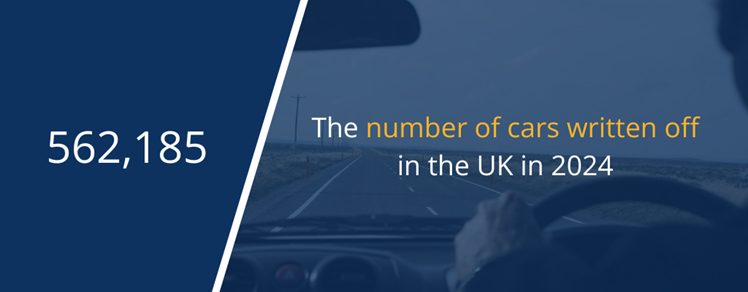
Being involved in an accident serious enough to write off your vehicle isn't something any of us expect, but it happens to hundreds of thousands of motorists each year.
DVLA data showed that 562,185 vehicles were recorded as written off during 2024, equivalent to roughly one every minute.
The same data indicated that recorded write-offs had risen considerably compared with 2017. The figures were reported following the DVLA Freedom of Information request here.
Of course, being written off doesn't automatically mean somebody suffers a large financial loss.
The size of any shortfall depends on the vehicle, its value, outstanding finance and the settlement offered by the motor insurer.
However, it does demonstrate why understanding what would happen financially following a total loss is worthwhile.
If you're involved in an accident, it can also pay to understand what the different insurance categories actually mean. We've explained them in our guide to car write-off categories.
Is GAP Insurance Worth It?
GAP Insurance can be worthwhile where the potential financial shortfall is large enough that you'd rather pay to insure against it than accept the risk yourself.
A simple way to think about it is this:
How much could you potentially lose if your car were written off tomorrow, and would that amount cause you a problem?
If the answer is several thousand pounds, GAP Insurance becomes considerably easier to justify.
If the potential difference is small and you could comfortably cover it from savings, you may decide it's unnecessary.
A Simple Example
Imagine buying a car for £30,000.
Two years later, depreciation means it's worth £21,000.
If it's written off and your motor insurer settles the claim at £21,000, you're £9,000 below the price you originally paid.
If you still owed £24,000 to the finance company, you'd also potentially have a £3,000 finance shortfall to deal with once the motor insurer's settlement had been applied.
A suitable GAP policy could provide additional cover against an eligible shortfall.
Now consider somebody who owns an older £6,000 car outright, has no outstanding finance and has enough savings to comfortably replace it.
That person might reasonably decide the extra insurance isn't worthwhile.
Neither decision is automatically right or wrong.
It's about the size of the risk you're taking.
When GAP Insurance Can Be Useful
GAP Insurance isn't for everyone, but there are several situations where it can offer genuine peace of mind.
New Cars
Newer cars can depreciate quickly, particularly during the first few years.
That means the difference between the amount you originally paid and the vehicle's market value can become substantial.
If you're interested in seeing what that might look like for your vehicle, try our Car Depreciation Calculator.
Cars Bought On Finance
If your outstanding finance balance is higher than your car's market value, a motor insurance settlement might not completely clear what you owe.
This is commonly referred to as negative equity.
It's particularly worth considering with PCP and Hire Purchase agreements, where the amount outstanding on the agreement and the vehicle's value don't necessarily fall at the same speed.
We've covered this in more detail in our guide to GAP Insurance for PCP cars.
Lease Cars
With a lease, you don't own the vehicle, but you could still face a financial liability following a total loss.
Your motor insurer's settlement may not necessarily cover the amount required by the leasing company to settle the agreement.
That's where a dedicated Lease and Contract Hire GAP policy can be useful.
If you're leasing rather than buying, read our guide answering whether you need GAP Insurance on a lease car.
Higher-Value Cars
Even where two vehicles depreciate by a similar percentage, the cash difference can be considerably larger on the more expensive car.
A 25% fall in value on a £15,000 vehicle is £3,750.
The same percentage on a £50,000 vehicle is £12,500.
That's why it's usually more useful to think about your potential shortfall in pounds, rather than concentrating solely on a depreciation percentage.
High-Mileage Drivers
Higher mileage can affect the market value of a vehicle, which can increase the difference between its value and what you originally paid.
If you cover considerably more miles than average, it's another factor worth considering when deciding whether additional protection makes sense.
Keep Your Car Protected With Direct Gap
Is GAP Insurance Worth It On A Used Car?
Yes, it can be.
GAP Insurance isn't purely for brand-new cars.
A recently purchased used car can still depreciate, and there can still be a significant difference between the price you paid and its market value at the point it is written off.
This can be particularly relevant if you've financed the purchase.
For example, imagine buying a two-year-old used car for £24,000.
After another two years of ownership, your insurer values it at £17,000 following a total loss.
That's still a £7,000 difference from the price you originally paid.
Whether Used Car GAP Insurance is worthwhile will depend on the size of that potential loss, how the car was purchased and whether the vehicle meets the provider's eligibility requirements.
Vehicle age, mileage, purchase date and value can all affect which products are available.
We've covered the subject in more depth in our guide to GAP Insurance for second-hand cars.
When GAP Insurance Might Not Be Necessary
That said, not every driver benefits equally.
Here are a few situations where you might decide GAP Insurance isn't necessary.
You Could Comfortably Cover The Shortfall Yourself
If you've got enough savings to absorb a potential loss without causing yourself financial difficulty, you may prefer to effectively self-insure the risk.
The Potential Shortfall Is Small
If your vehicle has already experienced the steepest part of its depreciation and there isn't a significant difference between what it's worth and what you owe, the benefit of additional cover may be more limited.
Your Existing Motor Insurance Provides Suitable Protection
Some comprehensive motor insurance policies include new-car replacement cover for a specified period.
The exact conditions vary, so don't assume you're covered. Check your own policy carefully to understand when replacement cover applies and what happens if your car is financed.
You also want to avoid paying twice for protection you already have.
You Own A Lower-Value Car Outright
If your car is owned outright and replacing it would be financially manageable, you may decide that accepting the depreciation risk makes more sense than paying for additional insurance.
Again, it's not about GAP Insurance being "good" or "bad".
It's about whether the protection is useful in your circumstances.
How Much Does GAP Insurance Cost, And Is It Good Value?
Cost matters, but the cheapest policy isn't automatically the best one.
It's worth comparing:
-
the type of GAP Insurance provided
-
maximum claim limits
-
policy duration
-
vehicle eligibility
-
exclusions
-
excess contributions
-
how claims are handled
-
who underwrites the policy
It's also worth shopping around rather than assuming the first product you're offered is your only option.
Make sure you're comparing similar levels of cover and that the product actually meets your needs.
You also don't have to purchase GAP Insurance from the dealership where you buy your car. We've covered your options in our guide to buying GAP Insurance privately.
Other Factors To Think About
GAP Insurance isn't one-size-fits-all, so there are a few other things worth checking before you buy.
Exclusions And Eligibility
Not all policies cover the same vehicles or circumstances.
Some products are designed specifically for leases, while others are suitable for cars purchased outright or through PCP and Hire Purchase.
Vehicle age, purchase price, mileage and how long ago you bought the car can also affect eligibility.
Don't simply assume a policy covers you because it's labelled "GAP Insurance".
Read the policy documents and check exactly what would happen in the event of a claim.
How Long You Plan To Keep The Car
Think about how long you're realistically likely to own the vehicle.
There's little point paying for a longer policy than you need, while buying too little cover could leave you uninsured during a period when the car is still depreciating.
Your Maximum Claim Limit
This can be easily overlooked.
If your potential shortfall could be £15,000 but your chosen policy only covers a maximum of £5,000, you could still be left substantially out of pocket.
Compare the claim limit with the vehicle's value and the level of depreciation you think is realistic.
How To Decide Whether GAP Insurance Is Right For You
If you're still undecided, ask yourself five questions:
-
What is my car worth today compared with what I paid for it?
-
How much finance would still be outstanding if it were written off?
-
Does my motor insurance already provide any relevant replacement cover?
-
How much of a potential shortfall could I comfortably pay myself?
-
Does the cost and level of GAP cover make sense compared with that risk?
If you know those answers, deciding whether GAP Insurance is worth it becomes considerably easier.
Don't buy it simply because somebody tells you that you need it.
Equally, don't dismiss it without understanding what you'd actually be liable for following a total loss.
Frequently Asked Questions
Do I Need GAP Insurance?
No. GAP Insurance isn't generally compulsory.
It's optional additional cover designed to protect against certain financial shortfalls following a total loss.
Whether you need it depends on the size of the potential shortfall and whether you're comfortable covering that amount yourself.
Should I Get GAP Insurance?
It may be worth considering if your vehicle is likely to depreciate considerably, you have a substantial finance balance, you're leasing the vehicle or you wouldn't want to fund a large shortfall yourself.
If the potential loss is small or easily affordable, you may decide against it.
Is Car GAP Insurance Worth It?
For some drivers, yes.
The best way to judge it is to compare the cost of the policy with the financial risk you're protecting yourself against.
A relatively small premium protecting against a sizeable potential shortfall may make sense to you. Paying for protection against a small loss that you could comfortably absorb may not.
Is GAP Insurance Worth It On A Used Car?
It can be.
Used cars still depreciate and can still leave owners with a considerable difference between their original purchase price, outstanding finance and an insurer's market-value settlement.
The key consideration is the size of that potential difference, rather than whether the vehicle was bought new or used.
Is GAP Insurance Worth It If I Paid Cash?
Potentially.
You don't need to have finance to suffer a loss through depreciation.
If you paid £30,000 for a car and later received a £20,000 motor insurance settlement after it was written off, you'd still be £10,000 below your original purchase price.
Whether protecting that difference matters to you is a personal decision.
Is GAP Insurance Worth It If I Have Comprehensive Insurance?
Comprehensive motor insurance and GAP Insurance serve different purposes.
Your comprehensive policy insures the vehicle itself and will generally base a total-loss settlement on its current market value.
GAP Insurance can provide additional cover for an eligible difference above that settlement, depending on the policy type.
Always check your existing motor insurance first, particularly if it includes new-car replacement.
Our Final Word
For many people, the attraction of GAP Insurance is less about trying to predict whether their car will ever be written off and more about knowing what would happen financially if it was.
Nobody expects to lose their car tomorrow.
But if it happened, would your motor insurer's settlement leave you owing money, struggling to replace the vehicle or considerably out of pocket compared with what you originally paid?
If the answer is yes, GAP Insurance may be worth considering.
If the potential shortfall is relatively small, you've already got suitable protection elsewhere or you could comfortably cover the difference yourself, you may feel perfectly happy without it.
That's really the point.
GAP Insurance shouldn't be treated as something every driver automatically needs. It should be considered against the car you own, how you've paid for it and the amount of financial risk you're willing to take yourself.
If you'd like to see what cover is available, you can get a GAP Insurance quote from Direct Gap, or get in touch with our team if you'd rather talk through the different options first.
Pin It!